



- Home
- News Room
- Patient Stories
- Softball Player Fully Commits with UCL Surgery

April 14, 2026
Lael Barnes knows firsthand that an injury can strike at any time.
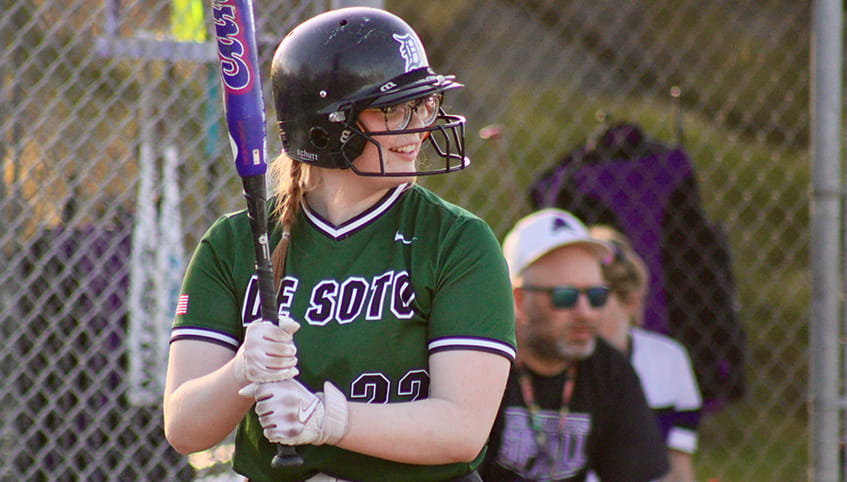
In the middle of her sophomore softball season at DeSoto High School, Lael was doing pregame warmups. She’s a right-handed pitcher but also plays outfield.
“I wanted to have a little bit of fun,” she says. “I’m throwing from the outfield, and my elbow pops. I don’t think too much of it, because I feel like my elbow pops all the time. So I go to throw again. I raise my arm, and I have this really big pop. And then sharp zaps of pain shoot up my arm.”
Lael sat out of the game, iced her right arm and returned to practice the following week. But Kara Steen, The University of Kansas Health system athletic trainer at DeSoto High School, strongly urged her to get it examined. Lael went to the health system for an X-ray and had a consultation with orthopedic surgeon Vincent Key, MD, who sent her for an MRI, which revealed a complete tear of the ulnar collateral ligament (UCL) in her elbow.
Dr. Key offered Lael several options including a full UCL reconstruction, also known as Tommy John surgery, or nonsurgical treatments with biologics or platelet-rich plasma.
“There are plenty of people that have injuries to their UCL that throw just fine. Everyone has wear of that ligament, whether you’re a high school athlete or a major leaguer. There are no pristine ligaments out there because throwing is not a natural thing,” says Dr. Key.
He explained that he assesses the integrity of the ligament based on command – how well they can throw the ball where they intend it to go – and velocity – the speed at which the ball travels. He uses that information along with an MRI scan to determine treatment options.
“We also do what’s called a FEVER view now, which is a stress MRI. We’re one of the few places in the Kansas City area that does it. Because an MRI is static view of the ligament, it’s a snapshot of the ligament. Now we can use the FEVER view, a stress view of the elbow, to see dynamically what that ligament is doing,” says Dr. Key.
Lael had a decision to make. Her pain would come and go with activity, but it was bearable.
“The bigger stressor was: Am I going to play again? That was weighing down on me more than the pain,” she says tearfully. “I had to decide if I wanted to keep playing softball. And I decided I still wanted to, so I got my surgery.”
With my technique, I don’t take the old ligament out. I actually incorporate the old ligament into the new ligament I’m making for her ... It’s the strongest construct out there." Vincent Key, MD
The strongest construct
Dr. Key’s UCL reconstruction involves taking tendon from elsewhere in the patient’s body – Lael’s came from her left hamstring – and inserting it to act as the new ligament.
“With my technique, I don’t take the old ligament out. I actually incorporate the old ligament into the new ligament I’m making for her,” says Dr. Key. “I get 3 strands of their own tendon that I took, and I use their own tissue as a fourth string. It’s straight in line with the normal ligament. I think that makes a huge difference in terms of stability and strength and overall outcome. It’s the strongest construct out there.”
And Dr. Key says he has the results to prove it. In more than 400 UCL reconstructions, he says he has had about 4 failures.
Coming out of surgery, Lael said she wanted to immediately get back to throwing. Instead, she had to spend 7-10 days in a hard cast.
“That was probably the worst time ever, trying to stay sane in that hard cast,” she says. “I wanted to move my arm so bad.”
But she got her wish before long. After about a week after surgery, she transitioned to elbow bracing and was referred to physical therapy.
Intentional, whole-body recovery
Lael worked with Kyle Veazey, PT, DPT, a board-certified clinical specialist and physical therapist at the health system.
Veazey explained that rehab after Tommy John surgery progresses in 3 phases. First, it’s all about getting the swelling down and working on elbow extension and light gripping. Then it’s focused on range of motion – including stretching and active range for their wrists, elbows, shoulders, hips and ankles. Finally, they build total body capacity, which focuses on the rotator cuff, shoulder and upper back muscles. He says they address the rest of their body in this last phase as well, as it includes dynamic exercises, lots of lower body effort and pre-throwing exercises.
“They get Tommy John surgery, and we certainly spend time rehabbing this. But we also spend a lot of time assessing the rest of their body and how it moves and where they might have deficits,” Veazey says. “We're addressing trunk and lower body range of motion, muscle strength, muscle endurance, coordination. We're really working a lot of movement coordination, which is sometimes called kinetic chain exercise or kinetic chain rehab.”
Why focus on the whole body?
“The elbow is a victim of everything else not being right,” says Dr. Key. Strengthening the kinetic chain is protective of the elbow and helps prevent future injuries.
Lael was still anxious to get back to softball, so she says PT felt like it was going slowly at first.
“And then I kind of got into it,” she says. “This is what I need to get back on track, and I was willing to do whatever it took.”
“She kept a great attitude, which is sometimes the hardest part,” Veazey says. “Especially in the first month, because you have to try to convince a high school athlete that the thing that they do the most of all – play softball – they don't get to do that. And not only that, but we have to protect their elbow, which means they can't do a lot of stuff during the day.”
Veazey said the length and intensity of the recovery can be hard for youth athletes to understand.
“This is a major surgery, and you need major physical therapy. This isn't like you come 3 times, and then you're back on the field,” Veazey says. “This is like 6-plus months of focused, intense physical therapy, and it's not always going to be super pleasant. But Lael did great. She has quite a personality, which is always fun. That makes my job easier when they're dynamic, and I would describe Lael as dynamic.”
In the end, Lael says the 7-8 months of PT felt like it went by quickly. Although she isn’t back to her presurgery throwing strength yet, she knows it is coming.
“I feel amazing. I’m so ready to play,” Lael says. “Every time I throw, I can feel myself continuously getting better. It’s so amazing to see after all the months of PT and all the work I’ve put in.”
She is looking forward to her junior season with the DeSoto Wildcats and plans to help build her team up and mentor underclassmen. After the last year of recovery, she has new lessons to hand down to other athletes experiencing setbacks.
“I’d definitely tell someone that a majority of it is mental. Know that everything is going to be OK,” says Lael. “All of it is a part of a plan, and you’re working toward the goal of getting back at your sport and being better all-around.”
Recommitting to the game after injury
Jessica Lovell, Medical News Network:
Lael Barnes love of the game started early with her brother and her dad.
Lael Barnes, high school softball player:
They're throwing in the front yard and I was like, I want to play.
Lovell:
It's just in the blood.
Barnes:
So I started playing catch with them, and I've always had like a really strong arm and they were like, “We got to get you signed up for softball.”
Lovell:
It started when she was 7. Now a junior at DeSoto, Lael pitches for her high school softball team. But years of love for her sport has put wear and tear on her arm. It was during a game in the middle of the season she threw and heard a pop.
Barnes:
I was like, it's probably fine. Happens all the time. So I go back to get in line, come back up to throw and I throw the ball, and then my arm just kind of drops. And it's like all these sharp pains, shooting pains up my arm, and I try to go back to lift it up and I can't lift it. It hurt. It hurt so bad. It was like probably the worst pain I've ever felt in my life.
Lovell:
She talked with her trainer, who referred her to Doctor Vincent Key, orthopedic surgeon with The University of Kansas Health System's sports medicine department and head team physician for the Kansas City Royals. An MRI revealed Lael had torn her UCL.
Barnes:
And I was like, wow, okay, season's over. Like, I guess I knew that there was a tear, but I wasn't sure how bad it was.
Lovell:
Dr. Key performed Tommy John surgery to replace and repair the damaged ligament. He told her it would take some time to get back on the field, but she could do it.
Barnes:
That was, like, probably the hardest 3 months of my life, because I still had to go to practices, and I'm just sitting there watching everyone else play. I'm like, oh my gosh, I just want to play so bad.
Lovell:
So Lael got to work with physical therapist Kyle Veasey at The University of Kansas Health System's Sports Medicine and Performance Center.
Barnes:
PT was actually, like, really hard because you just want to play so bad. You want to get back really soon, and you just can't because you just have to keep working through it until your body's ready.
Lovell:
After 7 months of tough but consistent physical therapy, Lael is back and beyond ready to pitch her first game.
Barnes:
It's just like full of excitement because I've been going through so many months of building my body back up, building my mental game back up, and it's just like, I'm ready. I'm so ready.